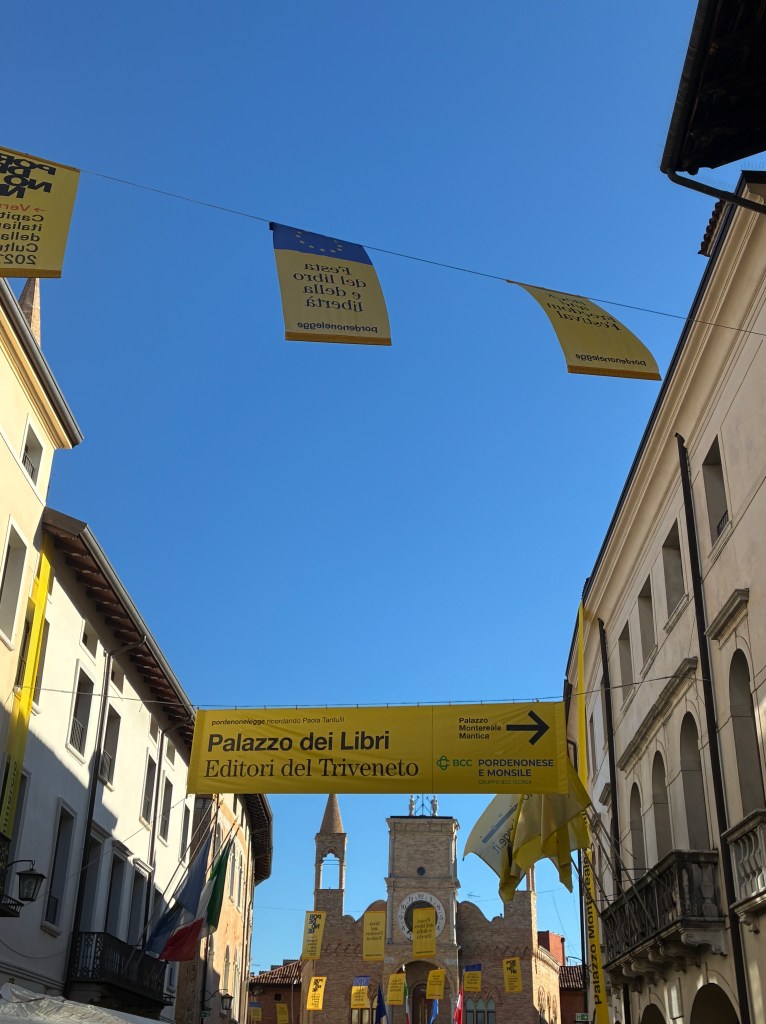
What a great start to this weekend! Yesterday afternoon I headed out to the lovely city of Pordenone, ready to dive deep into the festival. And did I! As soon as I stepped out of the train station and made my way to the city centre, I started breathing the joyful atmosphere of book lovers congregating. I absolutely love the fact that the festival takes place all over town, as it really lends an air of celebration to this delightful little city. As I had a bit of time before my only booked event for the evening, I took a little stroll to enjoy the sunshine and the amazingly blue sky.


I had a great start to the festival listening to Yaroslav Trofimov presenting his novel, No Country for Love (translated into Italian as Non c’è posto per l’amore, qui), in conversation with Federica Augusta Rossi.
No Country for Love is a historical fiction novel set in Ukraine in the 1930s-50s, exploring the ways in which “the meat grinder of History” destroys individual hopes, dreams, and families, leading individuals to make impossible choices in order to survive, which end up internally corrupting them. The novel’s protagonist, Deborah Rosenbaum, is a young woman who moves to the then-capital of Ukraine Kharkiv to make her own fate, and is based on the author’s own grandmother. In this book, the author shared, he sought to tell the history of his country through Deborah’s story.
It was a very rich conversation, spanning from the book and the author’s research process to the current global situation – and especially the continued war in Ukraine. Among other things, I found the author’s reflections on his writing process to be fascinating. Trofimov is a journalist, has extensive experience reporting from war zones, and has written non-fiction books as well. When he was asked about his experience with writing a fictional story, he shared some very thoughtful reflections on the power of fiction to almost fill in the blanks: when one writes non-fiction, they are limited to facts and what is ascertained, but there is no way to know what happened in-between recorded facts nor what individuals were thinking and feeling at any given time. Fiction instead allows an author to craft a wider narrative, sharing an emotional story, not simply a factual one.

However, that is not to say that facts have no place in a novel: Trofimov worked on this book for around 10 years (!), researching information on events and people in historical archives, weaving these real-life individuals into the narrative as secondary characters alongside the fictional ones. The author also reflected on the role of journalism and the impossibility of objectivity: journalists have a duty of honesty, sharing what they witness without spreading lies and fake news, but not one of impartiality as, in a situation of violence or injustice, they should never feel compelled to side with an oppressor for the sake of objectivity. I found this to be a very timely reflection, as in a number of conflicts around the world (especially, but not only in Ukraine and Gaza) journalists are increasingly targeted and propaganda is relied upon to justify actions which should never be justifiable, with space being given in public debates to propagate such ideas in the name of “objectivity” and “balance”.
Though Trofimov’s analysis of the current situation in Ukraine was extremely interesting and I enjoyed his reflections on the role of journalists in such situations, I was disappointed when he remained slightly non-committal when asked about the genocide in Gaza, attempting a diplomatic answer when, in light of everything he had just talked about would have expected him to take a more definite position against the oppressor and in defence of freedom as a “fundamental value”, as he’d shared in relation to the Ukrainian people.
Despite this, I really enjoyed the presentation and I am curious to read the book, especially as I’m not too familiar with the history of Ukraine in the first half of the XX century. If you’ve read the book, let me know what you thought of it in the comments!
Now, off to get ready for Day 2!
Discover more from Book for Thought
Subscribe to get the latest posts sent to your email.
