
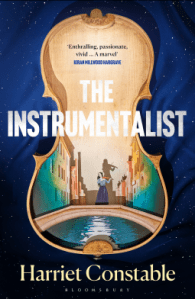
I received an advanced review copy of this book for free from the publisher via NetGalley and as part of the Instagram readalong campaign organised by Tandem Collective. This did not affect my opinion of the book in any way.
Publisher: Bloomsbury Publishing
Published: August 2024
Pages: 336
Synopsis
Venice. 1704. In this city of glittering splendour, desperation and destitution are never far away. At the Ospedale della Pietà, abandoned orphan girls are posted every through a tiny gap in the wall every day.
Eight-year-old Anna Maria is just one of the three hundred girls growing up within the Pietà’s walls – but she already knows she is different. Obsessive and gifted, she is on a mission to become Venice’s greatest violinist and composer, and in her remarkable world of colour and sound, it seems like nothing with stop her.
But the odds are stacked against an orphan girl – so when the maestro selects her as his star pupil, Anna Maria knows she must do everything in power to please this difficult, brilliant man. But as Anna Maria’s star rises, threatening to eclipse that of her mentor, the dream she has so single-mindedly pursued is thrown into peril…
From the jewelled palaces of Venice to its mud-licked canals, this is a story of one woman’s irrepressible ambition and rise to the top, of loss and triumph, and of who we choose to remember and leave behind on the path to success.
My Thoughts…
This is one of those books I really struggled to review (as evidenced by how late this review is actually being published, compared to the original date on the draft which has been waiting patiently for me to hit that “post” button for several months). On the one hand, I am always interested in narratives aiming to re-centre women, their experiences, achievements and fights for freedom after literal centuries of them being hidden, sidelined, and forgotten. On the other hand, I have been growing increasingly frustrated with “feminist” anything (be they retellings or historical fiction books) which seemingly use it solely as a marketing tool (and I do think that’s mostly to do with sales strategy rather than individual authors’ positioning). I have said this before, and I will say it again for as long as it’s needed: having a female protagonist does not make a book inherently feminist.
Although I’m by no means an expert, I enjoy classical music and, living very close to Venice, was immediately intrigued by the premise of this book, and longed to learn more about Anna Maria della Pietà and Vivaldi, two historical figures I wasn’t very familiar with beyond what is generally well-known. Sadly, my expectations fell mostly flat. This was due to a variety of reasons including the writing style, which I found to be highly repetitive and simplistic, unchanging even as time passed, so that Anna Maria spoke and thought like an adult even at the age of 8. I did like the fact that Anna Maria is described as having synesthesia, and I enjoyed the descriptions of vibrant colours while she played the violin. I was entertained enough to finish this, but by the end I was deeply frustrated and sad at another missed opportunity.
The Instrumentalist is based on the true story of Anna Maria della Pietà, an orphan raised at the Ospedale della Pietà, a brilliant violinist who displayed her musical prowess as a young child and was taught by Vivaldi, who also composed pieces specifically for her. This premise held incredible potential, telling the story of a woman who fought for her place in a patriarchal, misogynistic society, a talented musician relegated to a footnote in musical history. And yet…
I have a few issues with this book, but my main one is the character of Anna Maria herself. She is not simply unlikeable – which would be fine, unlikeable people exist and they often make for very compelling main characters. Anna Maria is essentially a proto-girlboss, single-mindedly ambitious and ruthless to excess, to the point that she comes across as inauthentic. I will happily accept that some of these character traits would fit Anna Maria’s circumstances more than generosity of spirit and kindness – it was a ruthless world after all. Where I draw the line is having an 18th century child worry about being “professional”, feeling concerned by being average or behind her peers, or barging into her highly acclaimed teacher’s office, making demands. This just feels lazy, as though taking a modern woman and inserting her forcefully into a historical setting.
This is compounded by one of the other main issues I had with this book, which is the way in which Vivaldi’s character is constructed. There is very little development there, as he is the object of Anna Maria’s adoration and fantasies of success for the majority of the book, only to be revealed as an opportunistic, abusive and cruel man, who full-on steals Anna Maria’s work for himself – and nothing less than La Stravaganza and the Four Seasons, his most famous works.
Now, I think we can all agree that certain men in history have been idolised and paraded as geniuses with probably little reason. And we can also agree that women’s contributions have frequently been overlooked or downright ignored. However, it is quite different to suggest that a composer’s most famous works were actually the fruit of his protégé’s work and stolen by him for his own greatness, effectively reducing him as a one-note villain. Especially when, as the author’s note admits, some events and timelines were shuffled around “for dramatic purposes”.
Just as it’s not enough to have a female protagonist to write a feminist novel, it is disingenuous to write male characters either as the driving force behind a woman’s accomplishments or as evil villains standing in the way of their success. Which brings me to another point: despite the novel seemingly aiming to bring to light a successful woman’s forgotten achievements, Anna Maria still exists only in Vivaldi’s shadow, either as his star pupil or as a victim of his own ambition. Her actual, historically documented, successes and the efforts that must have been needed to get her there are never shown: she is a prodigy, knowing how to play from the moment she picks up the violin and, despite the odds being stacked against her, she tends to get what she wants. For me, this diminishes Anna Maria’s achievements rather than celebrating them: her work is not worthy of being remembered if it cannot be linked directly to a man’s most famous creations, even if it becomes necessary to force historical events to make it so.
The other female characters in the book are almost non-existent except as fillers. Friends are discarded once they seem to be weighing down Anna Maria, then forgiving her for all kinds of awful behaviour without ever needing her to make amends; and the other girls are either too incompetent for her to be bothered with them, or rivals needing to be annihilated. To be clear, I wouldn’t expect something like “female solidarity” or “sisterhood” to appear as it would also be anachronistic. But the “figlie di coro” were professional musicians and composers in their own right, highly trained and renowned as one of the best orchestras in Europe at the time. To erase all of them and celebrate Anna Maria as the sole genius, demonising the previously revered male genius and substituting him with her, thus perpetuating the same patterns of idolisation without ever challenging them, ultimately feels like a betrayal and a missed opportunity.
Rating: 2/5

Discover more from Book for Thought
Subscribe to get the latest posts sent to your email.

I remember being intrigued by this but now I’m nervous. For some reason I imagined it would have lyrical prose so hearing about the writing is pretty disheartening. The feminist angle sounds very poorly done too though. It always frustrates me when books call themselves feminist but instead seem to simply be anti men. I read a dystopian novel a bit like that and every male was either a bad guy or completing lacking in any kind of backbone. Then for every female to also be weak idk. I’m not convinced about this anymore. I’ll leave it on my TBR for now but I’m definitely not in a rush to get to it.
LikeLiked by 1 person