


Hello everyone! Welcome back for my second stop on the Wizard of Ends blog tour! Huge thanks again to author Vanessa Finaughty for inviting me on the tour and for sharing another fascinating guest post with me! Today’s topic is mythical creatures that might have really existed.
Be sure to check out the other stops on the tour for more interesting posts!
Could these mythical creatures really have existed?
Some real animals, such as the platypus, giant squid and kangaroo, were once thought too far-fetched to be real – could other fantastical creatures also have been real once upon a time? Let’s take a brief look at a few.
Hydra

In Greek mythology, the hydra is a mythical water serpent with nine heads that were believed to grow back if cut off.
Descriptions of it are remarkably similar those of an octopus, and it was depicted as having spots similar to suction cups in Conrad Gessner’s 1604 encyclopaedia of the animal kingdom, Historia Animalium. It’s possible that the octopus was misidentified if the tentacles were mistaken as necks, but I’m not sure about the head – the end of an octopus tentacle looks nothing like a head. The regeneration is a no-brainer, since we now know that octopus tentacles regenerate if lost. My verdict: the hydra was likely an octopus.
Elves
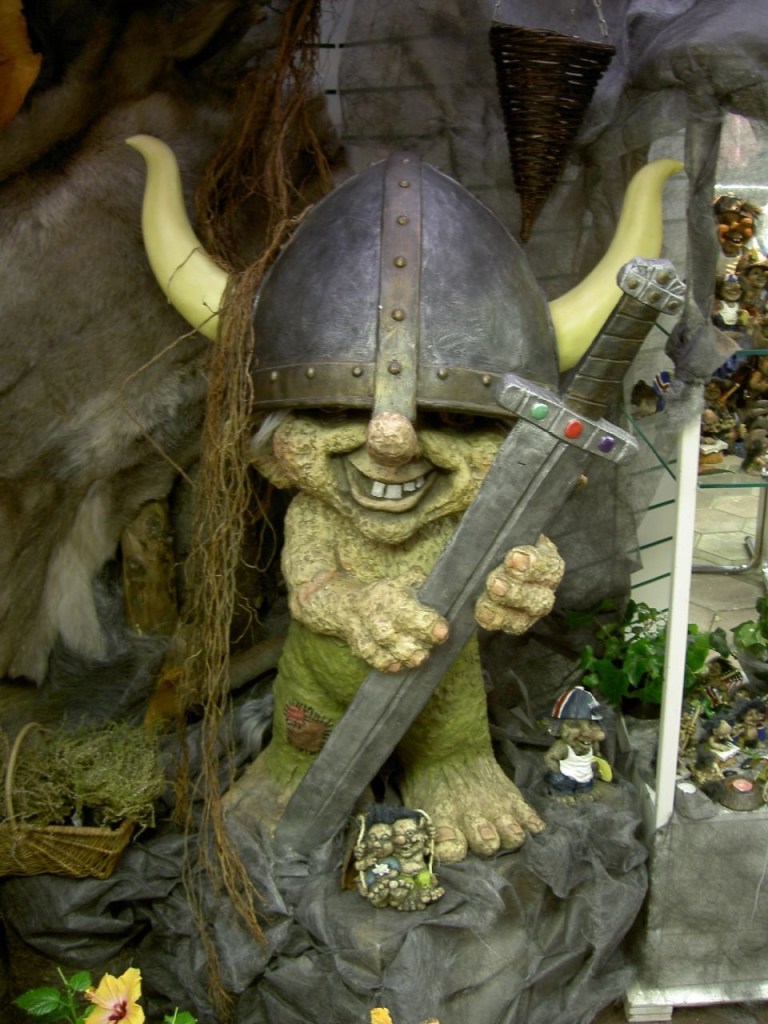
In Norse mythology, elves are small human-like beings that were known to have magical abilities and an affinity with nature, be mischievous and interfere in human affairs. While they were said to be helpful sometimes, they were also said to have stolen human children on occasion. A 1970 survey in Iceland revealed that 54% of interviewees still believed that elves existed or are likely to exist, to the point where, even today, no construction is done in areas were elves are believed to live.
There are two main theories about elves. One is that ancient people who had Williams syndrome were mistakenly believed to be non-human. Williams syndrome is a rare genetic disorder in which the afflicted are often described as having elf-like facial features. It’s also possible that elves were a now-extinct race of hominims (humans and our ancestors) or hominids (great apes and their ancestors). This is not such a stretch of the imagination if we consider that we’ve already found the fossilised bones of humanoids we didn’t know existed. Take the finger bone discovered in 2008 by Russian researchers in a cave in Siberia, for example – and it’s not the first. When the bone was analysed, it was revealed that it might belong to a human species of which we were previously unaware.
Ogres
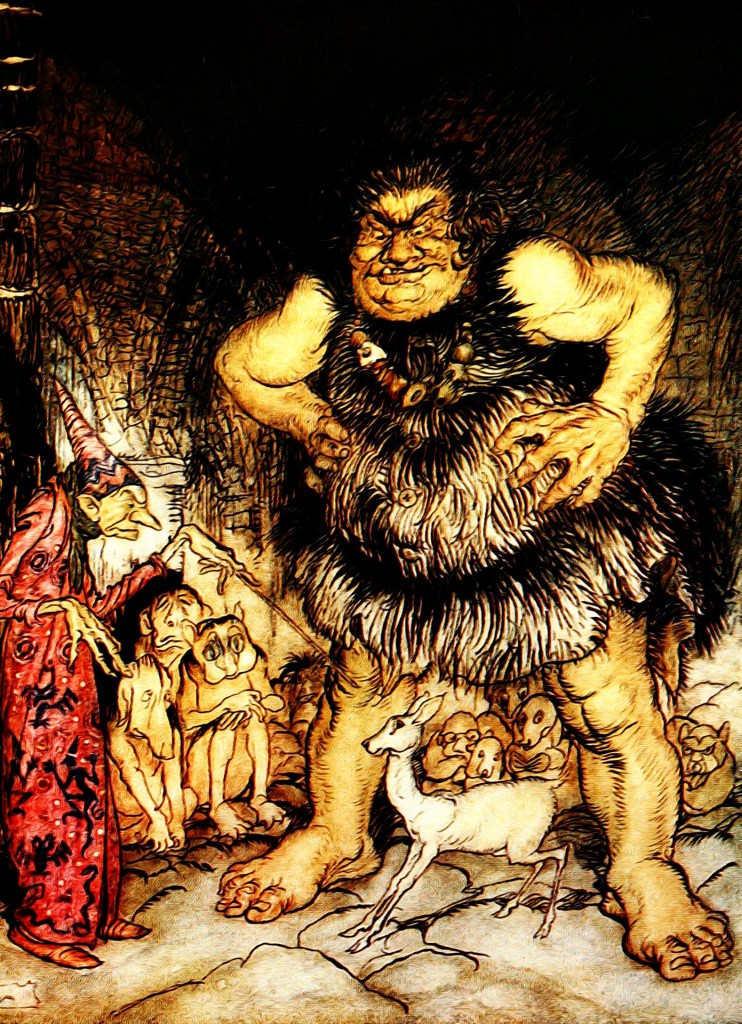
Mythology describes ogres as being huge, hairy, man-like creatures that ate humans and had green or blue skin. The idea of ogres is believed to have originated in Ancient Italy and Rome with Orcus, the god of the underworld. Known as the punisher of broken oaths, Orcus was often described as a bearded giant. Descriptions differ between Ancient Rome, Europe and Asia.
There is fossil evidence that Cro-Magnons (early modern humans) and Neanderthals inhabited the same parts of Europe and Asia at the same time. Some believe that ogre stories stem from encounters with Neanderthals – this doesn’t make sense to me, though, since Neanderthals were generally shorter than early humans were. Another theory has it that ogres are remnants of a Scandinavian forefather-worshipping cult. This also doesn’t ring true to me. I think this one is more likely to be pure mythology, or perhaps based on some other creature encountered in ancient times.
Harpies

CC BY-SA 3.0, via Wikimedia Commons
In Greek and Roman mythology, a harpy was a bird-human hybrid that had the body of a bird and the head of a human woman, and was sometimes believed to have been the spirit of storms.
I could find no theories of the origin of harpies, so it seems these were purely religious/mythological – unless, of course, they were ancient aliens come to visit humans (or a result of an ancient alien genetic experiment). I’m not sold on the idea, but I guess you never know.
Medusa

In Ancient Greek mythology, Medusa was a woman with hair of snakes who was so hideous that looking at her would turn you to stone. Sometimes depicted with wings, she was believed to be protect against danger and ward off evil. There are some variations of her story, but the ‘turning you to stone’ part appears in all of them.
Unless Medusa is pure myth, the only theory of her origins seems to be the ancient alien theory mentioned above. However, it’s interesting to know that there is actually a virus able to dry out and harden (‘turn to stone’) its host – thankfully, it seems its only host is an amoeba!
Phoenix

What we know today as the phoenix finds its origins in Ancient Egyptian mythology, where it’s symbolic of immortality, change and renewal. Its colour and size depend on the source, but it was often depicted as a heron-like bird with a long tail and colourful feathers. The Egyptians associated the phoenix with the sun god, Ra, and the underworld god, Osiris. It was believed that only one phoenix was alive at any given time – after living for a few hundred years, the bird was said to burst into flame, and a new, young phoenix was born from the ashes. Some versions tell of the sun heating the phoenix’s nest until it caught fire and the phoenix burnt, after which its eggs hatched from the ashes. Many cultures had a version of the phoenix. To the Ancient Egyptians, it was the Bennu. To the Greeks, the phoenix. To the Russians, the firebird. To the native Americans, the thunderbird. To the Japanese, the hō-ō. To the Chinese, the fèng huáng.
It’s generally believed that the phoenix was inspired by the Bennu heron, a now-extinct bird that inhabited what we know today as the United Arab Emirates. It’s also been proposed that the phoenix might have been inspired by flamingos that lived by the Nile River, with their feather colours of various shades of pink and red.

If you enjoyed this post, follow the Wizard of Ends virtual book tour for more!
About the author
Vanessa Finaughty is a multi-genre author who has published more than 20 books, including school books published by Oxford University Press Southern Africa. Vanessa grew up in Cape Town, South Africa, and still lives there with her husband and their four children (two human and two furry, four-legged).
Vanessa has always been passionate about books, and knew from a young age that she wanted to write them one day. She loves animals, coffee and the smell of wet grass, and hates excessive weather, long queues and liars. Her interests include reading, photography, the supernatural, mythology, aliens and outer space, ancient history, life’s mysteries and martial arts, in which she has five years’ experience in Ki Aikido.
Discover more from Book for Thought
Subscribe to get the latest posts sent to your email.

1 thought on “BLOG TOUR Guest Post: Could these mythical creatures have really existed?”